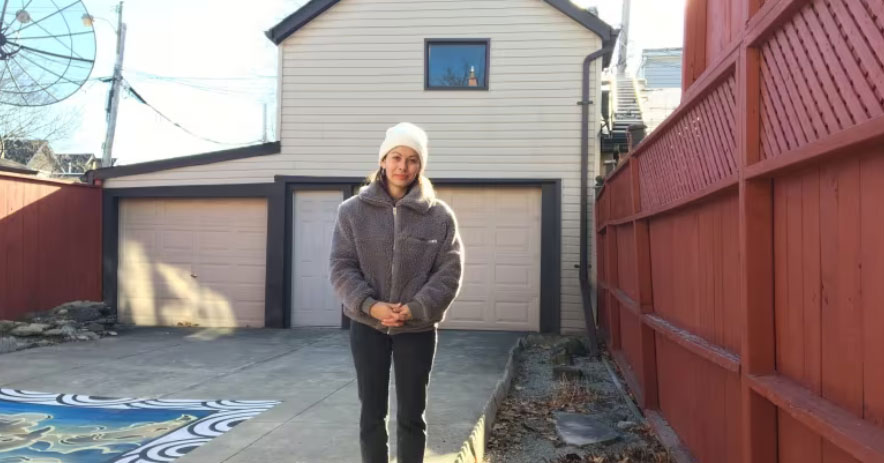
They may be considered tiny homes, but for many, Additional Dwelling Units (ADUs) are the big answer to getting a space of their own in a challenging housing market.
With ADUs being a relatively newer concept to add to the existing housing stock, Laneway Homes hosted an information session at the Essex Centre Sports Complex last Tuesday evening, where its reps informed around 60 community members how they can go about putting an Additional Dwelling Unit (ADU) on their properties.
Educating those interested in learning more about the process and benefits of ADUs was a big factor in the need to host the event, Dan Radmore, President and Owner of Laneway Homes, said. He used the opportunity to explain to those in attendance about what ADUs are, how they can be utilized on their property, the benefits and advantages, what the process entails, and the rules and regulations.
Laneway Homes, he explained, offers ADUs in the form of what many refer to as tiny homes. They can be attached to the existing main dwelling – similar to a duplex as it is an addition to the main dwelling, but has a separate entrance. They can also be detached, such as a garage conversion, that are typically located in the backyard. They are required to connect water and sewage to the main dwelling, Radmore added. They have separate utilities.
Based in Windsor, Laneway Homes is now servicing all the way to Chatham.
“We built, arguably, one of the very first ADUs in the city, and we’ve continued to just grow and build from there” Radmore said of Laneway Homes’ genesis. That first ADU, he added, was built in around 2018, shortly before Laneway Homes was created, under the multi-divisional company Supreme Restoration Services, of which he is CEO. “We realized there is a market here.”
The “More Homes, More Choice Act” of 2019 was implemented at the Provincial-level to increase the opportunities for a wider-range of available housing. That Provincial change has helped allow Laneway Homes to build ADUs for those who need them, following municipal by-laws. The company helps its clients walk through what those regulations are.
Back in March, the Town of Essex launched an ADU mapping tool that allows residents to fill in their address to see if they would be allowed to build an ADU in their existing dwelling or in the backyard on its website.
Sometimes, Radmore explained, residents may not qualify initially, but may be able to approach the Town’s Committee of Adjustment to consider a minor variance.
One concern he hears often is would an ADU be intrusive. Radmore explained many municipalities require the ADU be smaller than the main dwelling. He also hears concerns about drainage, but he noted Laneway Homes adds extra drainage and ties that into what is already existing. There are engineers involved to ensure it is done correctly.
Those looking to add an ADU can vary, from families looking to offer space for their senior parents or for adult children finding it challenging to get into the housing market. Investors may look to rent additional space to capitalize on what they already have.
He also noted it is not a long process. It takes around three-months, typically, from beginning to end, once permits are obtained. Even though Laneway Homes will help clients through that process, getting a permit can be complex.
“We want you to know, when we take it over, we take all that hassle out,” he said. “Our goal is to make the process as easy as we can.”
Those interested in learning more can log onto laneway-homes.com/
Mayor Sherry Bondy spoke at the information session, having had a tiny home built in her backyard in the recent past with this company. She had it built, so she could share the experience with the community.
“I am just here to share my experience and to highlight how easy it really was, and to hopefully encourage people to think about it as an option,” Bondy said.
Tiny homes, in her experience, are cheap on utilities.